e-Health Trends 2026: From Technological Promise to the Battle for Adoption
Looking back at #esante2026: our exclusive summary of the strategies unveiled by industry leaders.
90% of healthcare professionals now say they use AI. The figure is impressive, but it hides a more nuanced reality: the massive use of generic tools such as ChatGPT contrasts with a slower adoption of specialised business solutions. At the Grandes Tendances de la E-Santé 2026 event, leaders of the pharmaceutical industry drew a clear-eyed conclusion. The era of technological POCs (Proofs of Concept) is over. To create value in oncology and chronic diseases, innovation must now pass a single test: real-world use and human integration. Here is our analysis.
I. The Strong Signal: The technology is mature, adoption is still to be built
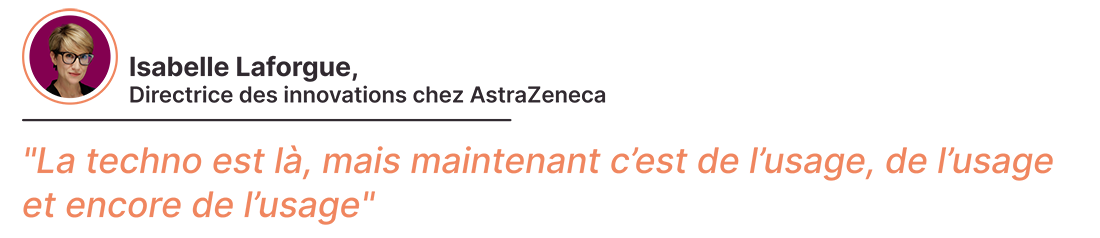
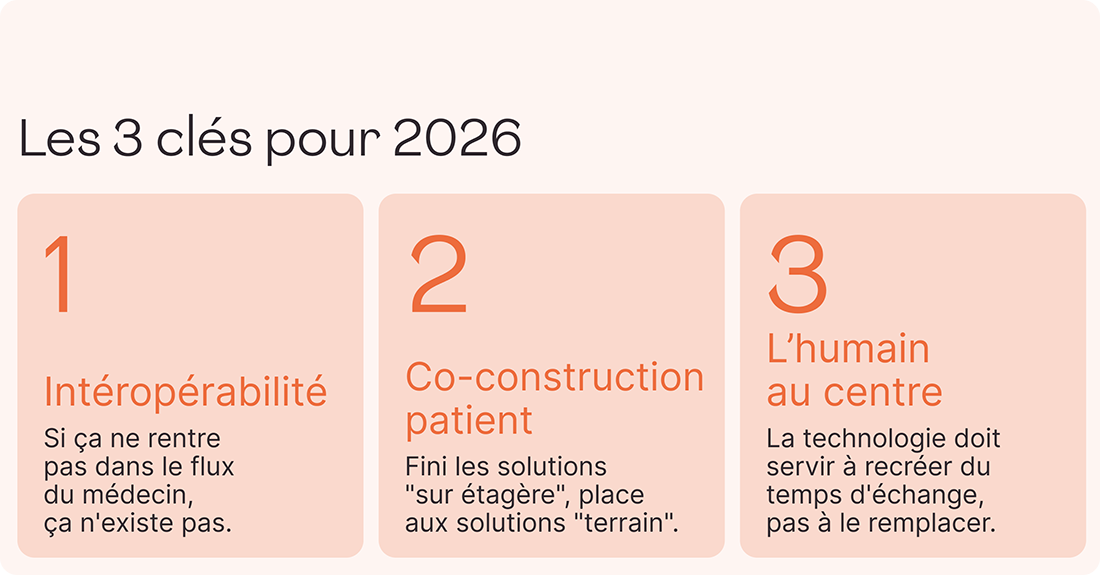
For years, the central question was: "Does the technology exist?". Today, the answer is yes. The new critical question, raised by Isabelle Laforgue, Director of Innovation at AstraZeneca, is: "How does the care pathway take ownership of this technology?".
The consensus is clear: technology must not be layered on top of caregivers' work, it must blend into it.
The partnership between AstraZeneca and IPSO on COPD (chronic obstructive pulmonary disease) illustrates this ambition. With 3.5 million patients affected and an average diagnostic delay of 7 years, the challenge is not to provide yet another digital gadget, but a diagnostic support tool that is fully interoperable with GPs' practice software. If the tool adds clicks without immediate medical value, it will not be used.
II. Paradigm Shift: Building "With" rather than "For"
The era of theoretical "Patient Centricity" is giving way to a pragmatic co-construction approach. Tania Aydenian, Head of Value Based Partnerships at Takeda, highlights a major cultural pivot: "We no longer build for patients, we build with patients".
The facts are stark: rare diseases now affect 3 million people in France, and 25% of them go through a diagnostic odyssey (lasting up to 5 years). Faced with this challenge, technology alone is not enough.

The role of the pharmaceutical company is changing. It is no longer just about supplying the molecule, but about bringing together patients' expectations, the constraints of the healthcare system and the possibilities of technology. The goal is not to add one more solution to the catalogue, but to identify the one that delivers measurable value across the patient's life journey.
III. The Continuum Challenge: Prevent, Support, Cure
Medication can no longer be the only answer. Etienne Tichit, CEO of Novo Nordisk, and Delphine Pagano, CEO of Bayer France, agree on the need for a holistic approach.
For Novo Nordisk, innovation must cover the full spectrum: innovating on the molecule to cure, but also acting upstream on symptoms and downstream on support, without making the patient feel "over-medicalised". At Bayer, the conclusion is similar: "However good a treatment is, it can only be effective if it is properly prescribed and properly taken". Delphine Pagano does, however, point to a major risk: the fragmentation of care pathways. Digitalisation must not isolate the patient or further fragment care. On the contrary, it must free up what the current system lacks most: medical and human time.
IV. Jinko's Vision: The Architect of Connection
These talks validate Jinko's core thesis. The pharmaceutical industry is no longer looking for digital service providers, but for care pathway architects.
Having an app or an algorithm is no longer enough. You need to be able to:
- Guarantee interoperability so as not to add to caregivers' mental load.
- Provide human support that gives meaning to the data collected.
- Turn this "Patient Experience" into usable real-world evidence (RWE) to prove the clinical and economic value of treatments.
This is precisely where Jinko comes in: we do not replace care, we create the operational link that allows therapeutic innovation to deliver its full promise in the patient's home.
Satisfied patients and doctors
“Jinko is my new haven of peace.
The kindness, the listening, the care, the follow-up, the practitioners… The nurses are very attentive, always ready to help, to improve the follow-up and adapt it. Jinko helps me every day: I have been able to take up (adapted) physical activity again and take back control of my body.
Thank you to the whole team who welcomed me into the care pathway.”
“Jinko is a precious, essential and beneficial resource for anyone living with cancer or in remission. The care pathway offered is tailored to my needs, I discovered new therapies, and the network of selected practitioners is of very high quality: attentive, empathetic, supportive, caring… Thank you to the whole Jinko team for your commitment, your support, your humanity and the strength you give us!”
“Jinko was a precious support for me during my cancer treatment, filling the gaps that often exist in medical follow-up. The team stands out for its empathy, compassion and commitment to supporting patients in every aspect of their lives, during and after treatment. Thank you to Sophie and the whole team for their exceptional humanity and unmatched availability.”
“Jinko works hard to understand patients’ needs as closely as possible and knows how to support them at the right time, in the right way. Doctors need people to take over from them, and it is a very good thing that Jinko has taken this initiative.”