
Cognitive impairment: how the CogBOOST project tackles the invisible complaint of life after cancer
CogBOOST: a hybrid programme to treat cognitive difficulties after breast cancer and support the return to work.

Post-cancer-treatment "brain fog", or "cognitive impairment", is no longer a clinical myth. It is now one of the major factors affecting women's quality of life after breast cancer, and one of the most persistent obstacles to their return to work. Up to 75% of women treated for breast cancer report difficulties with memory and concentration after their treatment.
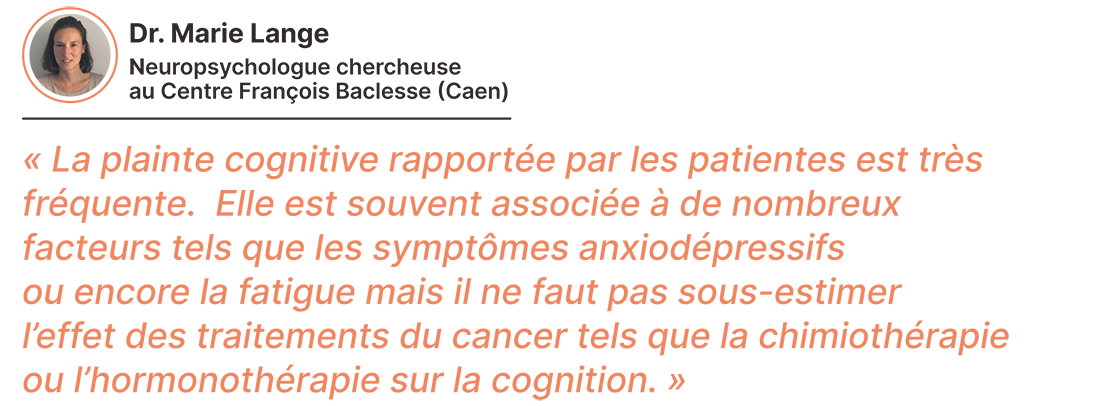
To address this challenge, the CogBOOST project has first-class scientific backing. It is led by Prof. Florence Joly and Dr Marie Lange, respectively a university hospital professor of medical oncology and a neuropsychologist-researcher at the Centre François Baclesse (Caen), and pioneers of research on cognitive impairment in oncology. Their work, carried out within INSERM unit U1086 "Anticipe", has placed this issue at the heart of supportive cancer care in France.
Making the invisible visible: objectifying the complaint with real-world data
The complexity of cognitive impairment in oncology lies in its multifactorial nature.
Cognitive impairment can be assessed through:
- Validated, standardised self-assessment questionnaires, whose reliability is recognised by the scientific community, to measure the cognitive complaint, the factors associated with it and the impact of these difficulties on daily life.
- Cognitive tests to assess the functions most affected by cancer treatment (such as processing speed, memory, attention and executive functions).
Hybridisation as a lever for engagement and adherence
CogBOOST is a supervised, personalised digital programme designed to help women with breast cancer who report cognitive difficulties.
CogBOOST is not just a self-guided remediation app. Prof. Florence Joly and Marie Lange's team made the strategic choice of a hybrid model to secure patients' long-term adherence. The 12-week programme is built on an alliance between the digital tool and human support.
After an initial online assessment of cognitive difficulties, the personalised and supervised programme is built around three interventions:
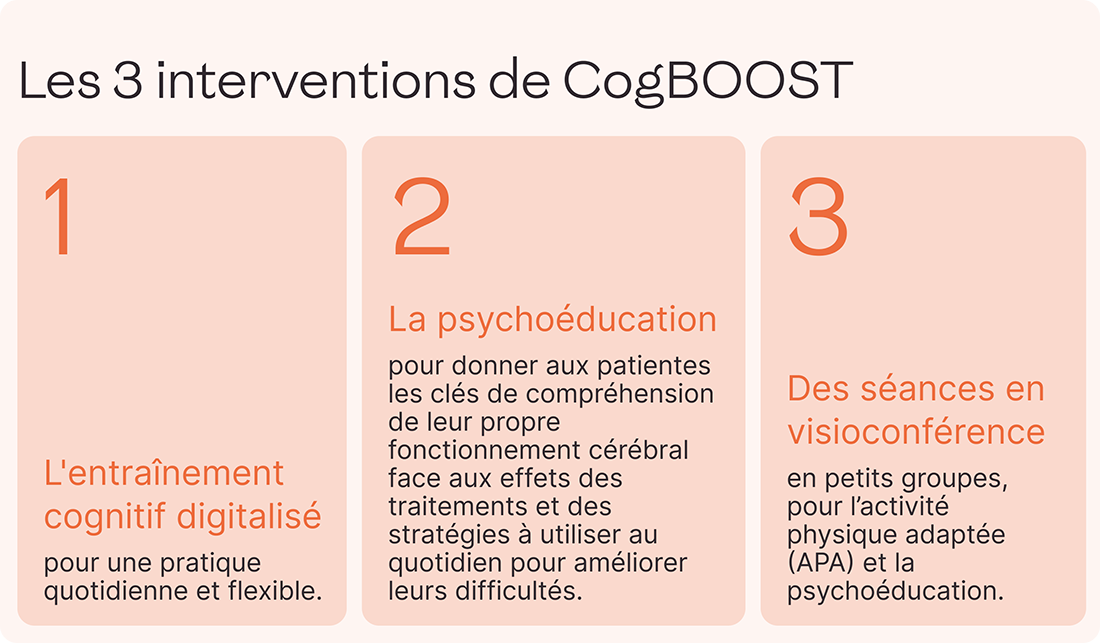
The last 2 interventions are supervised respectively by a psychologist-neuropsychologist and adapted physical activity (APA) professionals during video sessions, which helps maintain a strong therapeutic relationship. By avoiding isolation in front of a screen, CogBOOST encourages patients to adopt compensation strategies that they can then transfer directly into their daily life and even their work.
From co-construction to national roll-out: progress to date
The development of CogBOOST, supported in particular by the Normandy region and AstraZeneca, has just reached a key milestone: the co-construction phase with patients (including patient-researchers from the association Les Sentinelles, patients from the Centre François Baclesse and an expert patient) is being finalised. This feedback is used to adjust the tool so that it fits real-life conditions and the expectations of its future users.
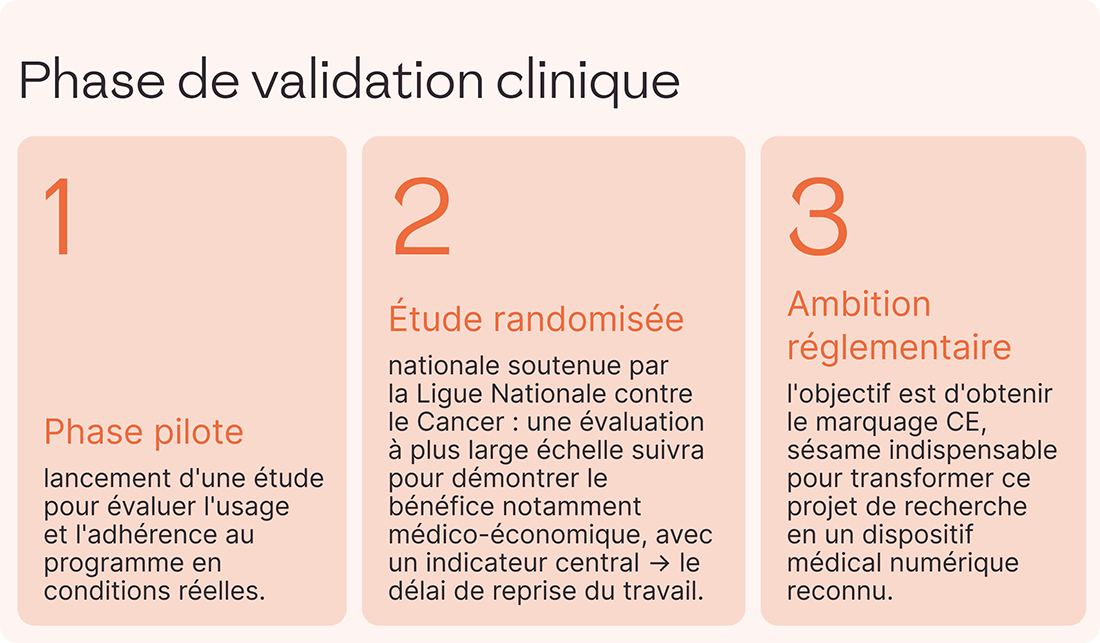
The project will then move into a structured clinical validation phase:
Return to work: the new marker of success in oncology
The financial support of AstraZeneca through the In'CaRe call for projects illustrates the pharmaceutical industry's strategic shift towards "Beyond the Pill". The challenge is no longer only overall survival, but the efficiency of the care pathway. By investing in solutions that support return to work, healthcare players are responding to a growing demand from the authorities (INCa, the French National Cancer Institute).
This programme, which stems from 15 years of research within INSERM unit U1086 "Anticipe", shows that organisational innovation is as crucial as molecular innovation. By turning an invisible complaint into a coordinated care pathway, CogBOOST positions itself as the missing link in supporting patients with cognitive difficulties.
Sources:
- CogBOOST platform
- INSERM unit U1086 Anticipe
- National platform Cancer et Cognition
- AstraZeneca France Lab In'CaRe
- Association Les Sentinelles
- INCa recommendations

Satisfied patients and doctors
“Jinko is my new haven of peace.
The kindness, the listening, the care, the follow-up, the practitioners… The nurses are very attentive, always ready to help, to improve the follow-up and adapt it. Jinko helps me every day: I have been able to take up (adapted) physical activity again and take back control of my body.
Thank you to the whole team who welcomed me into the care pathway.”

“Jinko is a precious, essential and beneficial resource for anyone living with cancer or in remission. The care pathway offered is tailored to my needs, I discovered new therapies, and the network of selected practitioners is of very high quality: attentive, empathetic, supportive, caring… Thank you to the whole Jinko team for your commitment, your support, your humanity and the strength you give us!”
“Jinko was a precious support for me during my cancer treatment, filling the gaps that often exist in medical follow-up. The team stands out for its empathy, compassion and commitment to supporting patients in every aspect of their lives, during and after treatment. Thank you to Sophie and the whole team for their exceptional humanity and unmatched availability.”

“Jinko works hard to understand patients’ needs as closely as possible and knows how to support them at the right time, in the right way. Doctors need people to take over from them, and it is a very good thing that Jinko has taken this initiative.”